Why “Leadership Effectiveness” is Your Competitive Advantage

Every organisation has its critical performance indicators: profit, turnover, market share, growth, % rework, staff engagement and customer satisfaction – but what actually drives those numbers?
There is one underlying key metric that rules them all. “Leadership Effectiveness” is the strongest single predictor of business performance.
As a leader, you are in a highly influential position. You hold responsibility for critical operations, key decisions, investment choices and have a direct developmental impact on the people who make the business run.
Simply put: for your organisation it is mission-critical that you are the most effective leader you can be.
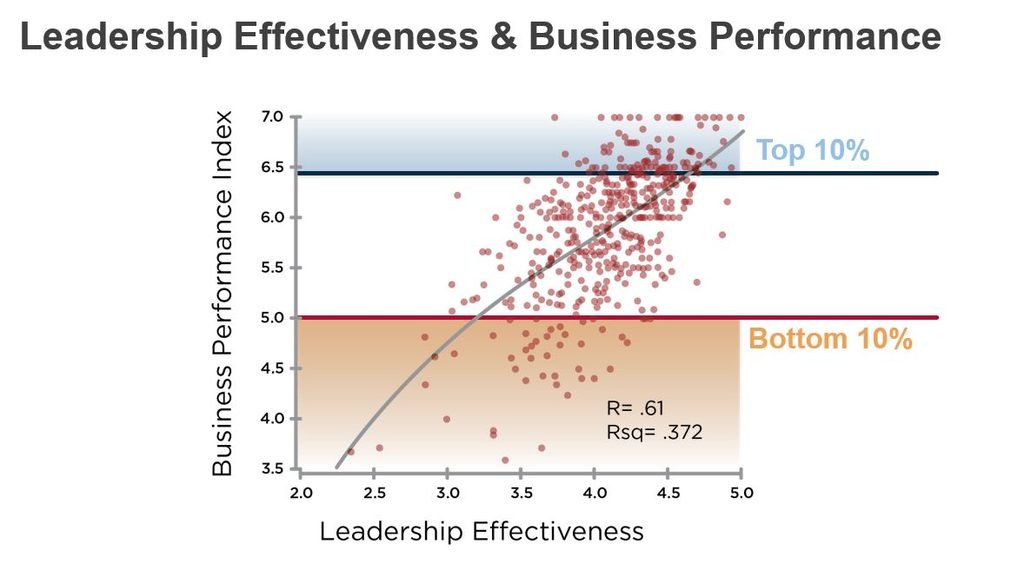
The Leadership Gap: Breaking Through the Plateau
If leadership is so critical, why do so many organisations struggle to cultivate it?
Think about the journey of a dedicated marathoner. Through grit, discipline, and a solid training block, they cross the finish line in an impressive 3:15. It is a massive achievement.
But what happens when they set their sights on a sub 3h Boston Qualifier time? Chances are that simply running more miles or pushing the exact same training plan harder won’t get them there; it will just lead to burnout.
They have reached a performance plateau.
To break through to that higher level of performance they need a new training approach. They don’t discard the valuable aerobic base they’ve built, but they do have to shift their focus. It might mean more targeted threshold work or tracking HRV to inform smarter recovery.

The transition to senior leadership is exactly the same. Most businesses promote talented individuals based on their drive, technical skills and past successes (their 3:15 marathon). But as the famous saying goes:
“What got you here won’t get you there.”
When you step into roles with more bottom-line influence, impacting more people, the old formula quickly plateaus. You won’t lose your technical brilliance, but you do have to shift your focus, style and approach. You need to show up differently.
Your line manager will know what results they want to see from you, but they often lack the time, language and specific coaching frameworks to help you design the necessary new “training block” needed for you to flourish.
The Leadership Circle offers objective analysis. It provides a proven and accessible leadership model. You will finally have access to sound and supported choices giving you the confidence to grow.

What Does “Effectiveness” Actually Mean?
As high-achievers progress in their career they often sell themselves a heavy, stressful story: “If I just work harder, put in more hours, and control the outcomes, I’ll be a better leader.” But is that true? Can you really squeeze 28h from a day? Effectiveness isn’t about white-knuckling through the pressure or micromanaging more processes. It’s not about spinning more plates even faster.
True effectiveness is the ability to scale your impact with greater ease. It is the shift from reacting to problems out of stress, to creatively driving vision with purpose.
It means dropping the heavy armour of having to “do it all,” and stepping into the flow of true leadership—building resilient teams and achieving high-level results without burning yourself out in the process. Sounds great – but how is it done?
A 100% Positive Opportunity
Having the opportunity to take part in a Leadership Circle assessment isn’t remedial. It’s not training to fix something that is broken.
It’s likely you already have a strong track record of success. You are already naturally capable, resourceful, and whole. But think about it, top teams who want great performance use coaches.
In sport we see coaches with specific roles eg. strength and conditioning, nutrition, psychology, motor skills, mental strenth or physiotherapy. Coaches frequently show up in entertainment, and in world-class businesses. It is an investment reserved for high-potential employees who have a vital role to play in the future of the organisation.
Stepping into a Leadership Circle Profile (LCP) coaching program is an invitation to look in the mirror and see just how powerful you truly are. It is an opportunity to recognize the trusted, effective skills and habits you already have AND to explore new, expansive ways of leading. The ultimate goal?
For you to find alignment, lead with authentic impact, and play the most fulfilling game of your career.

Speaking personally, when I took the LCP for the first time I was “blown away” by the depth of the resource. I had no idea that I was viewed this way within the organisation.
I suddenly had clarity on what direction the business needed me to take and where I could free up my behaviours to empower others. That change would give me the space to grow into my own potential and give them the space to make their own contribution.
The compassion and insight of the coach leading my debrief was a rich and moving experience. Nothing negative. All simply neutral information for me to apply as I wished. I also noticed that taking the LCP helped my line manager find a language and a vehicle to articulate what he needed from me in a way that had not been expressed before. That was priceless – for both of us.
Just What is 360° Feedback?
(and the stories we tell ourselves)
Not Just Another Personality Test
Unlike a typical leadership assessment—which often relies entirely on your own self-perception—a true 360° assessment gives you a comprehensive, multidimensional view of your impact. It gathers confidential, anonymous feedback from the people who experience your leadership every single day: your bosses, your peers, and your direct reports. It evaluates your skills, your influence, and your overall effectiveness from every angle.
The Leadership Circle Difference
Most assessments only track surface-level behaviour. The LCP goes deeper. It is unique because it is the only 360° instrument that maps both your inner mindset and your outer behaviour. By measuring your Creative Competencies alongside your Reactive Tendencies, it doesn’t just show you how you are perceived—it reveals the internal operating system driving those perceptions.
The Stories We Tell Ourselves
(and why it feels scary)
Let’s be honest: the thought of opening a 360° feedback report can feel terrifying. If your stomach churns at the idea of being evaluated by your peers, you are in very good company.
Our egos absolutely hate being measured. Our Saboteurs love to take the idea of feedback and spin it into some heavy, dramatic narrative about our worth. We often attach a stressful story to the process:
“If they point out my blind spots, it means I’m failing as a leader.”
But just take a moment to look at this thinking—”I’m failing as a leader.” Is that actually true? Would a company really invest in an emerging leader they thought was a liability or had no future? Of course not.
If you’ve taken the free PQ Saboteur assessment (link here), you know how easily we get hijacked by habitual, self-sabotaging thoughts. Any apprehension you feel is completely natural, especially if you’ve heard of feedback being weaponized. Just notice if your ego is inventing a groundless, fictional story that will only work to hold you back.
Applying “Sage Discernment” to the Process
Releasing the fear doesn’t mean ignoring the logistics. You are entitled to transparency. You are in control of selecting your evaluators, and all of your peer and direct report evaluators have total anonymity. While HR may sometimes request a copy of your report (always ask if this is the case in your organisation), remember that the information itself is completely neutral. It’s 100% up to you how it lands.
The endurance parallel : It’s all just data on your Garmin
Think about being midway through an ultra run. You glance at your watch and see your pace has dropped. You don’t stop on the trail and declare yourself a terrible athlete. You accept it for what it is: completely neutral data. It is simply a mirror showing you exactly where you are on the course.
360° feedback is exactly the same. It is not a judgment of your character or a test you pass or fail. It is simply GPS data for your leadership journey. It shows us where you are naturally flying, where you might be creating unnecessary tension, and what’s needed for your next block of training.

A Safe Space and Zero-Judgement Zone
There is one more crucial reason you can relax into the process: you don’t navigate through this alone, and you won’t be defending or justifying the report with your line manager or HR. Your LCP results are delivered and unpacked in a confidential, one-to-one debrief with a certified, external coach. They are outside of your organisation. Carry zero corporate baggage, have no political agenda. Their sole interest is to support you. Working with you to define the future you want for yourself.
When we review your profile, I don’t see a leader who needs fixing. I see a magnificent, highly capable human being who is ready for their next stage of growth.

Navigating Your Internal Operating System
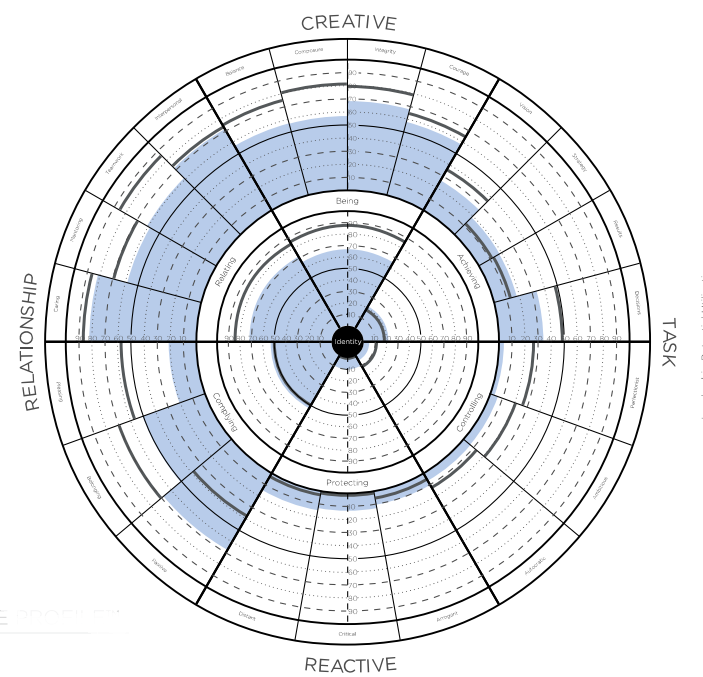
Let’s take a quick look at the actual map we will be using: the Leadership Circle circumplex. It isn’t just a chart of behaviours; it is a visual representation of your internal operating system. It tells us how you see yourself and how you are perceived by those in the business and your wider sphere of influence.
The circle is divided into two distinct hemispheres: a “Reactive” bottom half and a “Creative” top half.
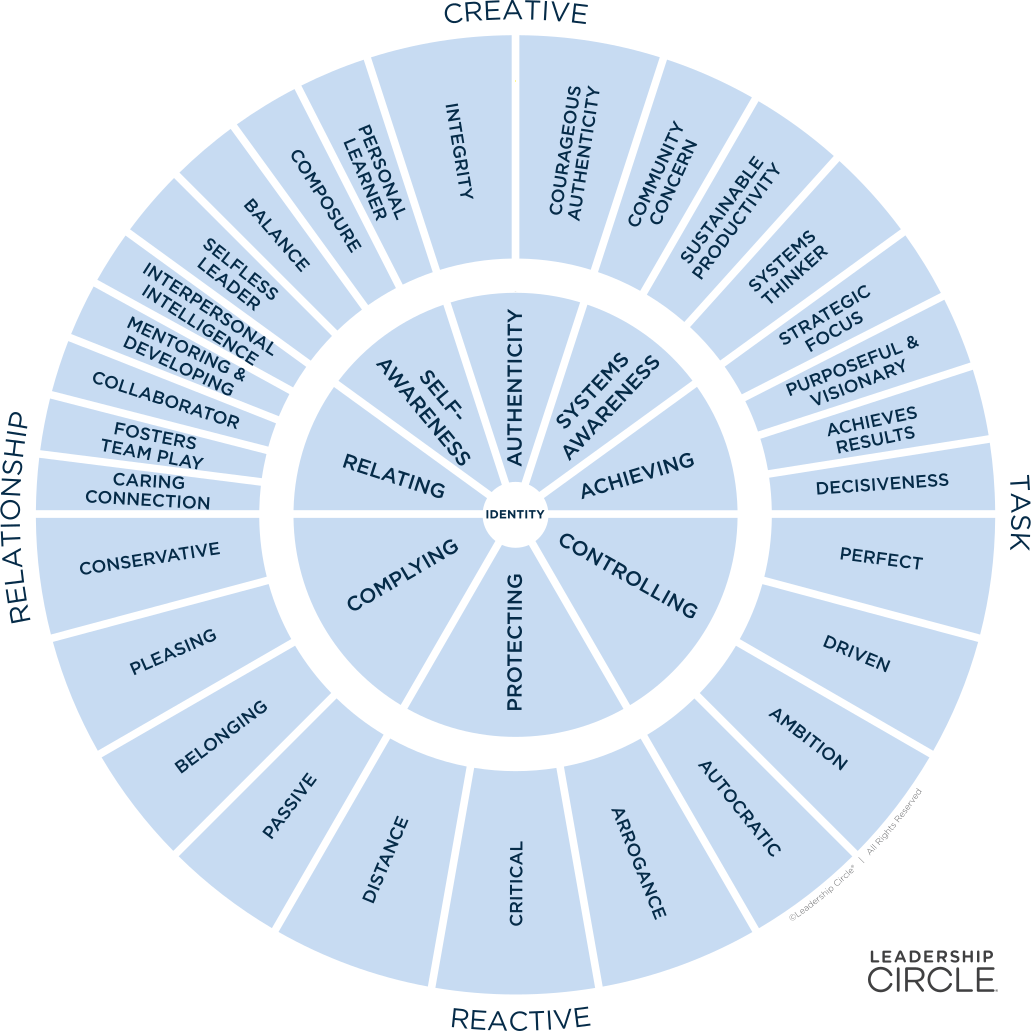
The Headwind Slowing You Down: Reactive Tendencies
The bottom half of the map illustrates your Reactive tendencies. If you are familiar with Positive Intelligence, this is exactly where your Saboteurs live—the Controller, the Hyper-Achiever, the Pleaser, and the Judge.
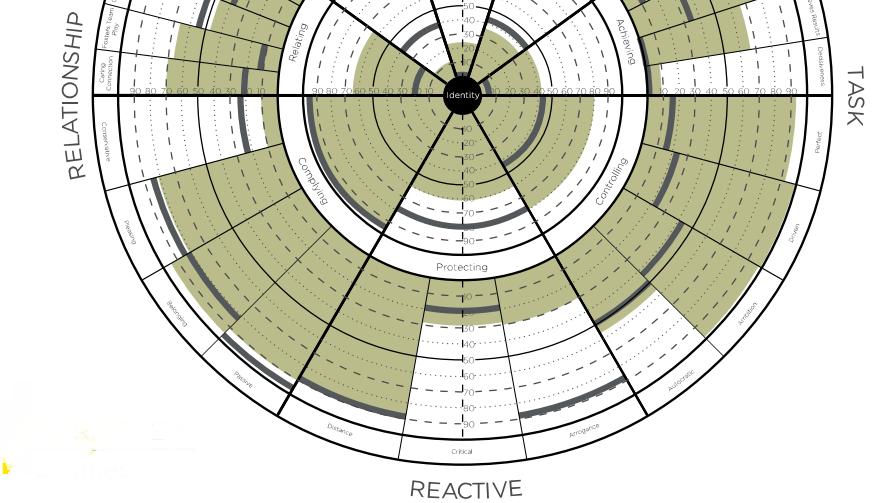
In endurance terms, leading from the Reactive half is like running into a brutal, relentless headwind. Yes, you are still moving forward and hitting targets, but it requires a massive, exhausting expenditure of energy. This operating system is fuelled by caution, comfort, ego-protection, and fear.
You can think of Reactive traits as defaults. In many cases they were natural areas of strength for you. For example it’s a real strength to be courageous, decisive, willing to take responsibility and have a natural bias for action. These attributes get an individual noticed and promoted.
However, these strengths become self-sabotaging the moment you are hijacked by fear—specifically, the fear that if you don’t tightly grip and command every variable, circumstance, or person around you, everything will fall apart or you will be hurt. This becomes the domain of the Controller.
The Controller creates a heavy burden for you and those around you because it demands that you force outcomes rather than flow with them, turning your natural leadership into stressful rigidity. As you’ll find out, Saboteurs promise success but deliver the opposite.
The Tailwind Driving Success: Creative Competencies
The top hemisphere of the circle maps your Creative competencies. In the Positive Intelligence framework, this is the realm of your Sage. But let’s be very clear: this isn’t a list of innate personality traits that you either have or you don’t. The Creative dimension provides a proven, evidence-based model for successful leadership. It is broken down into specific competencies—like Relating, Self-Awareness, Systems Awareness, and Achieving—that can be systematically acquired, practiced, and mastered.
Think of a freestyle swimmer looking to shave seconds off their time. They don’t just flail harder in the water. They break down the stroke, understand the bio-mechanics, practice the drills, and apply them lap after lap until they become muscle memory. Leadership is exactly the same. None of us start out knowing how to execute these competencies flawlessly.
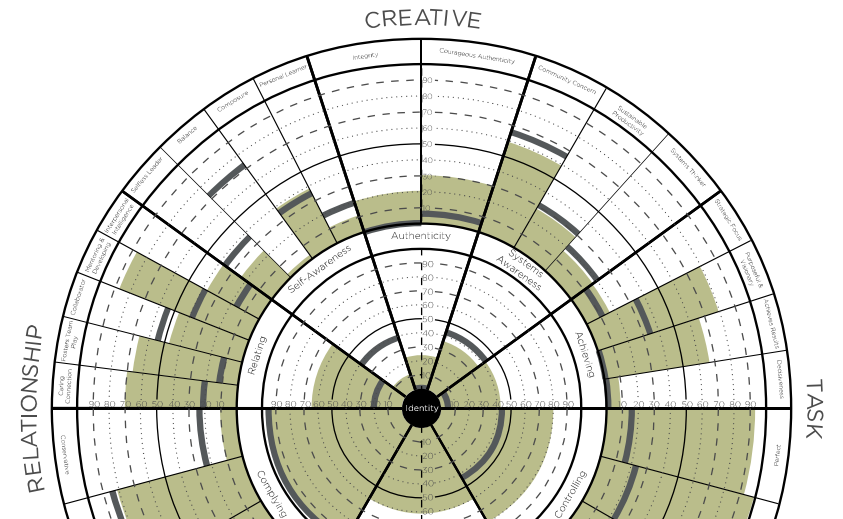
Leading from the Creative hemisphere gives your performance a massive tailwind. When you deliberately practice and master these competencies, you drive far greater business results. And you’ll do it with a profound sense of ease and flow. You no longer have to force outcomes. Just like freestyle these management skills can be practiced and learned. You have the capability to learn these skills, master this model, and play at the very top of your game.
There’s so much more depth to the design of the circle that we can’t go into here but during your 1:1 debrief it’s the coach’s job to make the graphic come alive. You’ll see yourself reflected with real clarity and have a choice of directions leading towards even greater Leadership Effectiveness.
Choosing Your Starting Line: LCP vs. The Manager Edition (ME)
In triathlon, we often start out racing a sprint distance simply to take part, using the sport as a vehicle for health and wellbeing. But once the bug hooks you, the goalposts move. You start chasing a Personal Best. Eventually, you might set your sights on becoming age-group competitive, or even qualifying for Team GB.
You can race at an elite level in any distance—sprint, middle, or long. The distance isn’t the point. The point is that the nuanced skillset, the precise data tracking, and the mechanics required to qualify for Team GB are vastly different from what is needed to simply “take part.”
Leadership is exactly the same. It is a journey of continuous growth. To support you as your career becomes more complex the Leadership Circle offers two different instruments. Both the full Leadership Circle Profile (LCP) and the Manager Edition (ME) are built on the exact same advanced core model. Both tools bypass surface-level symptoms to reveal the underlying, motivating habits of thought that drive your outward behaviour..
The Manager Edition (ME): Honing the Fundamentals
The Manager Edition is designed specifically for mid-level managers, project managers, supervisors, and team leaders. It is important to note that this is not a traditional assessment of basic management skills like planning, organising, directing, and controlling. Instead, it evaluates true leadership competencies for those in roles that are less complex than senior executive positions.
The Full LCP: The High-Performance Data Set
The full Leadership Circle Profile is suited for the intense complexity of senior leadership roles, such as CEOs, Presidents, Vice Presidents, and Directors. However—and this is crucial—it is also the exact tool used for managers considered “emerging leaders” and high potential managers who have demonstrated strong leadership potential.
A Lifelong Training Partner
Just as a serious cyclist wouldn’t use their FTP (Functional Threshold Power) or VO2 max data from three seasons ago to design today’s training block, your leadership data isn’t meant to be static. The Leadership Circle isn’t a “one-and-done” event; it is a complete ecosystem designed to support your entire career. Take the ME as a manager, progress to the LCP as a leader. Retake the assessment every 2-3 years. Your capacity for growth is limitless – let the Leadership Circle be your partner.
The Starting Line: How the Process Works
There are two terms to familiarize yourself with: you are the Participant, and the people giving you feedback are your Evaluators. Your coach will handle the heavy administrative lifting so you can focus entirely on the road ahead. When we get started you will personally receive an email directly from The Leadership Circle giving you access to your own self-assessment. It takes just 20-25 minutes. Be in quiet space with phones off.
Step 1: Anchor Your “Why”
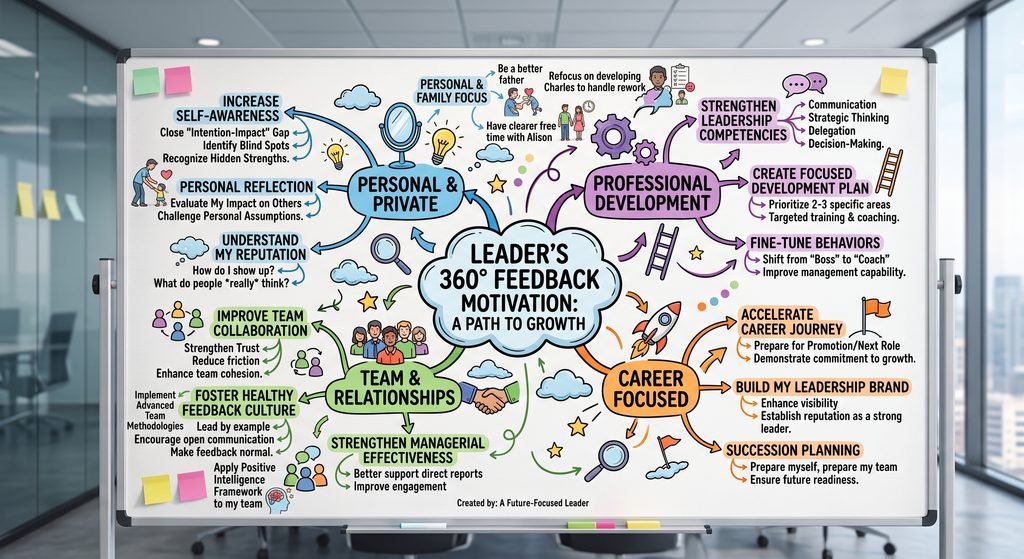
Before you invite a single person into this process, take a quiet moment to journal or mind-map exactly why you are doing this.
What is your true goal and hope for the process? Is it to increase your effectiveness, prepare for your next career transition, or find greater alignment and ease? Get highly personal. Maybe it’s to delegate more at work so you can be more present with your family when you get home. Be honest. Ask yourself: For the sake of what am I doing this? Keep this note private; it is your anchor to come back to when the work gets challenging.
Step 2: Assembling Your Evaluators
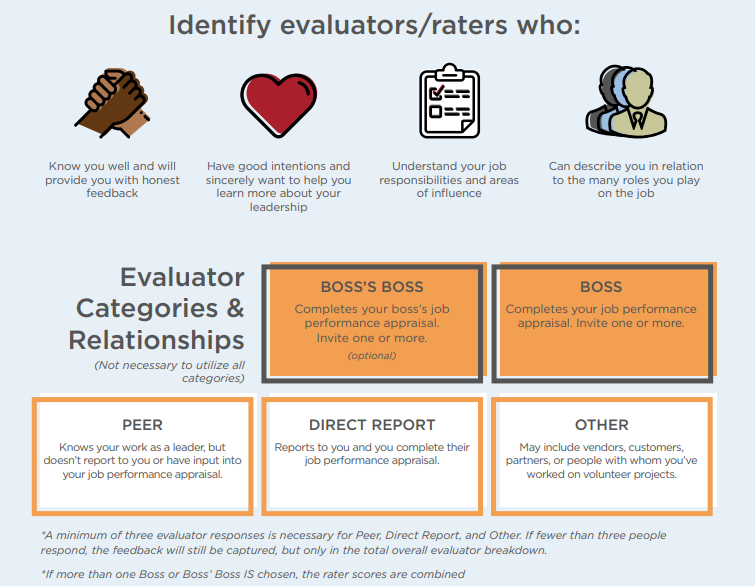
To get the most accurate data on your leadership, we want a wide, authentic dataset. In my experience a minimum number would be 12. If you can gather 24+, that is a fantastic and robust dataset. You’ll be provide with an Excel spreadsheet to list your confirmed evaluators, their relationship to you and their email addresses. You periodically send that spreadsheet to your coach as evaluators confirm they will take part (see “The Ask” below). You will select people across the following categories:
The Golden Rule of Selection: Drop the story that you need to “pass” a test. Do not just pick people who will flatter you. Choose people who know you well and whose honest perspective you trust and respect. (Note: To guarantee absolute anonymity for your Peers, Direct Reports, and Others, their data is aggregated. Select at least 4 people per category to ensure this grouping).
Step 3: The Ask
The survey is comprehensive, also taking your evaluators about 20-25 minutes to complete. Because you are asking for their valuable time and focus, the best “buy-in” happens when you personally reach out to ask for their help before the official system emails go out. I will provide you with a simple email template. You can edit it and personalize it as you wish, then send it to your selected evaluators to get their pre-agreement, and confirm their best email addresses. Once you hand that list to me, I will take over any follow-up – keeping us on track for the completion date. It’s my experience that people are always very willing to help. They are often flattered that you respect them enough to ask.
Our “Training Plan”: What Happens Next
So, you have anchored your “why” and assembled your evaluator team. What does the actual coaching block look like?
Growth requires both structure and reality. We are not going to just look at a chart and send you back to work; we are going to integrate this map directly into the messy, daily reality of your leadership. Here is our roadmap:
We have covered a lot of ground on this page, but every leader’s specific terrain is unique. If you have any questions about the process or how the Leadership Circle applies to your current career trajectory, my door is always open. Drop me a line at John@MindFitAthlete.com